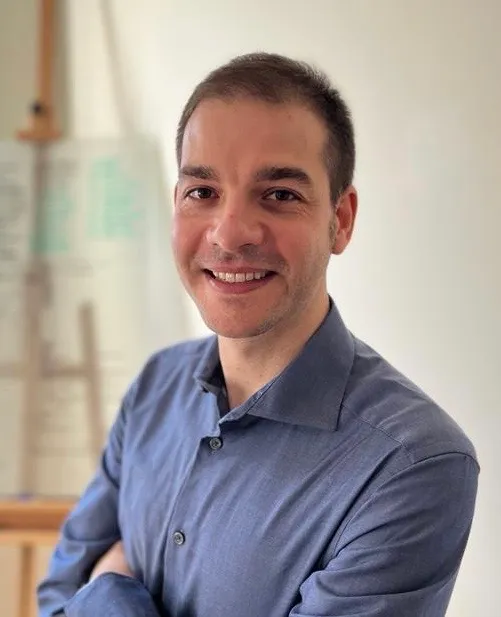
Giuseppe Leuzzi
IFOM ETS - the AIRC Institute of Molecular Oncology
Biography
I am a Group Leader at the AIRC Institute of Molecular Oncology (IFOM), where I lead the Functional Genomics of Cancer Immunity laboratory. My research program leverages high-throughput functional genomics to uncover how DNA repair mechanisms and genomic instability shape tumor–immune interactions and responses to immunotherapy
I received my training in Molecular Genetics at the University of Rome Tor Vergata and completed my PhD in Genetics and Cell Biology at the Italian National Institute of Health, where I developed extensive expertise in DNA repair biology. During my doctoral work, I identified WRNIP1 as a novel factor cooperating with the DNA damage response gene BRCA2 to prevent chromosomal instability and characterized the role of the WRN helicase in the replication stress response. I also investigated the interplay between mismatch repair and base excision repair in human gastric cancer, contributing to a broader understanding of genome stability in cancer.
In 2017, as a postdoctoral fellow, I joined the laboratory of Prof. Alberto Ciccia at Columbia University Irving Medical Center, where I investigated the role of the DNA damage response in cancer immunity. During this work, I developed a novel FACS-based CRISPR–Cas9 screening strategy that enabled the large-scale identification of DDR factors controlling cancer cell–intrinsic immune signaling and PD-L1 immune checkpoint expression. In 2022, as an Associate Research Scientist, I expanded my research program by contributing to the implementation of CRISPR-dependent base editing screens to model cancer-associated single nucleotide variants at scale, further advancing the application of precision genome editing in cancer biology and immunotherapy.
Since establishing my independent research group at IFOM in 2025, my research program has applied functional genomics and precision genome editing to dissect how defects in DNA repair and genome instability rewire tumor–immune interactions and with the goal of identifying actionable cancer dependencies relevant to immunotherapy.
Relevant Publications
- Mapping multimodal phenotypes to perturbations in cells and tissue with CRISPRmapGu J., Iyer A., Wesley B., Taglialatela A., Leuzzi G., Hangai S., Decker A., Gu R., Klickstein N., Nature Biotechnology (2025).
- Mapping variant effects on anti-tumor hallmarks of primary human T cells with base-editing screensWalsh Z.H., Shah P., Kothapalli N., Nikolenyi G., Shah S.B., Leuzzi G., Mu M., Ho P., Abuzaid S., Brodtman Z.D., Nature Biotechnology (2025).
- SMARCAL1 is a dual regulator of innate immune signaling and PD-L1 expression that promotes tumor immune evasionLeuzzi G., Vasciaveo A., Taglialatela A., Chen X., Firestone T.M., Hickman A.R., Mao W., Thakar T., Vaitsiankova A., Huang J.W., Cell (2024).
- Functional interrogation of DNA damage response variants with base editing screensCuella-Martin R., Hayward S.B., Fan X., Chen X., Huang J.W., Taglialatela A., Leuzzi G., Zhao J., Rabadan R., Lu C., Cell (2021).