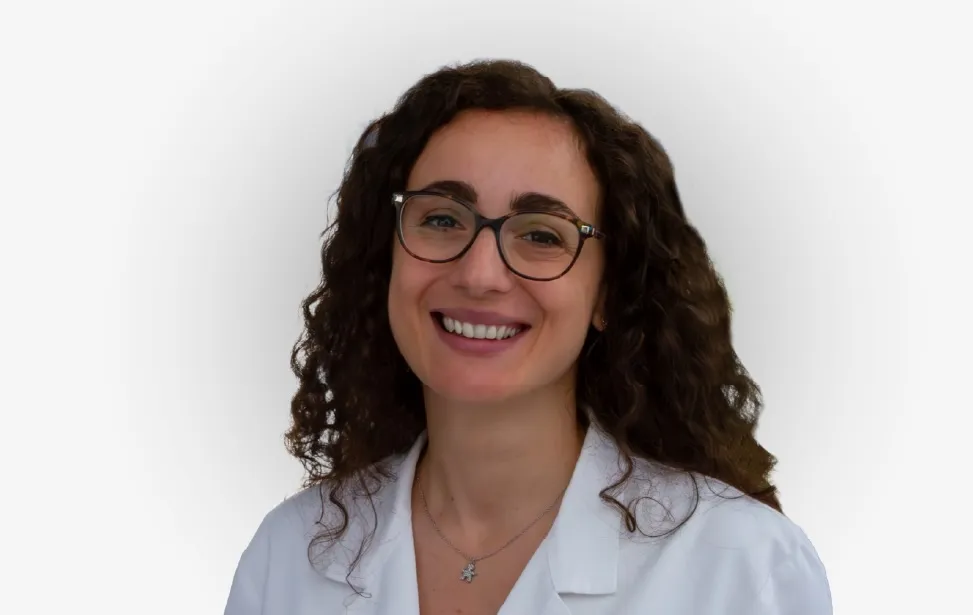
Giuseppina D'Alessandro
IFOM ETS - the AIRC Institute of Molecular Oncology
Biography
Born in 1988, Giuseppina D’Alessandro graduated in Medical Biotechnology at the University of Bari. After completing her studies in 2012, she moved to Milan where she obtained a PhD in Molecular Medicine at IFOM. Her doctoral research, conducted under the supervision of Dr. d’Adda di Fagagna, focused on elucidating the role of RNA and DNA:RNA hybrids in the repair of DNA double-strand breaks, one of the most deleterious type of DNA lesions. Following her PhD, Giuseppina was awarded an international fellowship through the iCARE-2 program, co-funded by AIRC and the European Union under the Marie Skłodowska-Curie Actions. This prestigious fellowship took her to the United Kingdom, where she joined the laboratory of Prof. Sir Steve Jackson at the University of Cambridge. During her postdoctoral experience at the Gurdon Institute and subsequently at the Cancer Research UK Cambridge Institute, she broadened her knowledge of DNA damage response pathways exploiting cutting-edge genome editing technologies, including CRISPR knock-out, inhibition, and base editing approaches. After five years in the UK, Giuseppina returned to Italy to establish and lead the Functional Genomics Screening Unit at IFOM. In this new role, she applies her knowledge of genome editing and CRISPR screening technologies to support IFOM scientists and to investigate DNA damage response mechanisms at scale.
Relevant Publications
- USP37 prevents premature disassembly of stressed replisomes by TRAIPKochenova O.V.*, D'Alessandro G.*, Pilger D., Schmid E., Richards S.L., Nature Communications (2025).
- RAD54L2 counters TOP2-DNA adducts to promote genome stabilityD'Alessandro G., Morales-Juarez D.A., Richards S.L., Nitiss K.C., Science Advances (2023).
- BRCA2 controls DNA:RNA hybrid level at DSBs by mediating RNase H2 recruitmentD'Alessandro G., Whelan D.R., Howard S.M., Vitelli V., Renaudin X., Nature Communications (2018).